
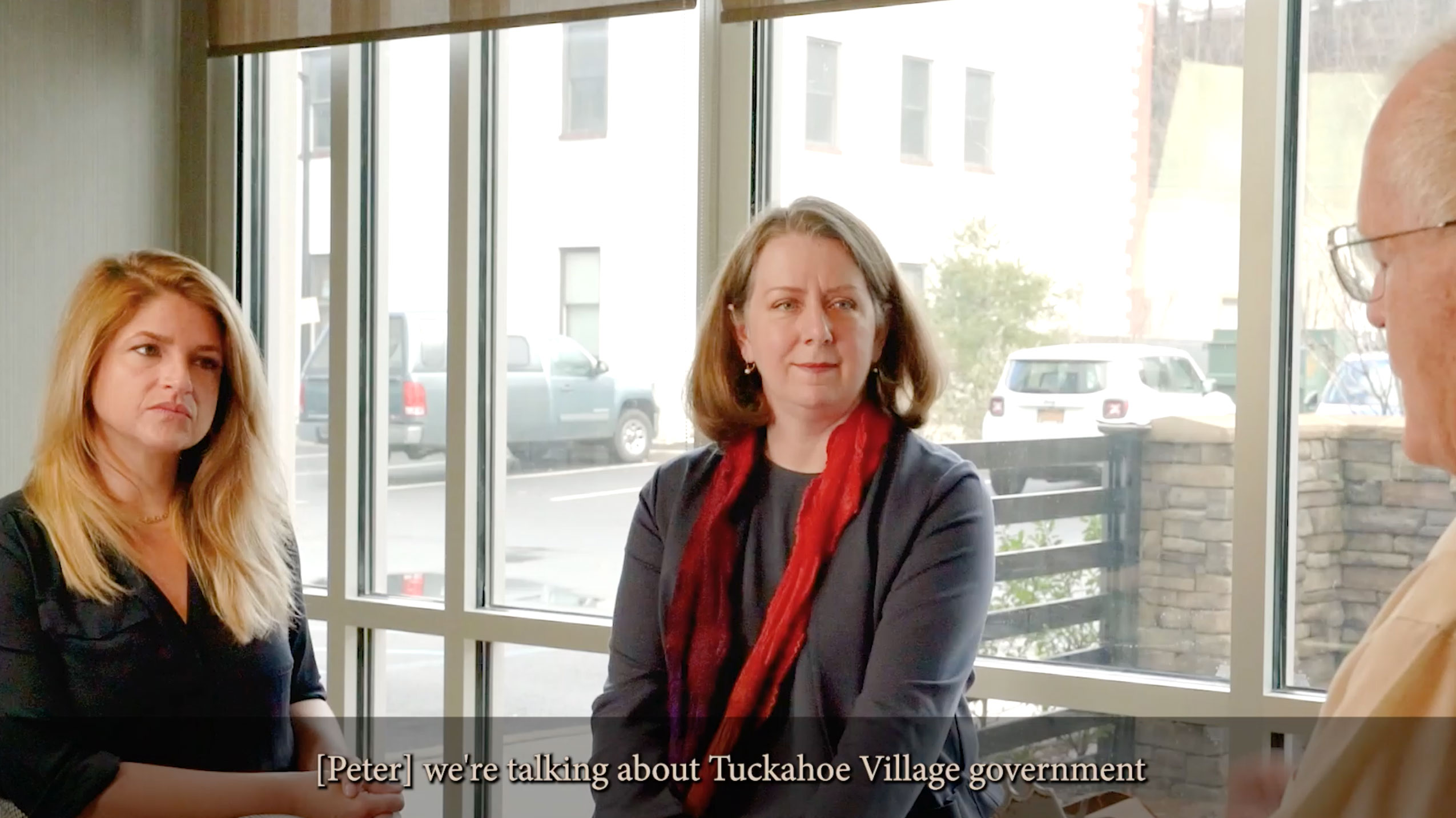
 Cara Kronen and Nicole Engelbert talk with retired local reporter Peter Drumsta about serving in public office, updating Tuckahoe's Master Plan, and more! Watch the video and read the transcript here.
Watch the video
Read the transcript
On serving in public office
[00:00]
[Peter Drumsta] We're talking about Tuckahoe Village government with Cara Kronen, Trustee, and Nicole Engelbert. Cara, holding a public office is a hell of a commitment, so Tuckahoe must mean much more to you than just a zip code. What brought about your wish to, not just live in the village, but to give back and serve?
[00:18]
[Cara Kronen] So I'm actually originally from the Bronx, and my mom was a teacher. And my family's whole career path has always been in public service, so it was nothing new. I was a teacher, a public school teacher, for a long time, and then I'm now a professor at CUNY. My whole life has been about public service, so it was really important for me.
I feel very lucky and really, really happy to be able to live here in Tuckahoe. I came to Tuckahoe about 20 years ago. I actually became part of the Yoga Haven community. And I became a teacher there in 2007. And when my husband and I would walk around the Village, we would say, this is where we want to live, we want to be here. And so, for us, it was really important to try to move here. And when the opportunity came about, we jumped on it. We chose Tuckahoe, and we continue to choose Tuckahoe every day.
So, for us, it was really important to be active in the community. And when the time came to be of service, I just jumped on it. For me, this was a no-brainer. I love everything about being a Trustee and everything about the Village, and I only want to see it be the best version of itself.
[01:34]
[Nicole Engelbert] So, my family moved here in 2015. So we don’t have as long a history as Cara and her family do. But, similarly, we actively chose Tuckahoe. We fell in love with the Bella Vista neighborhood. We fell in love with the economic and racial and religious diversity, and the diversity of perspectives, in our charming and wonderful Village.
But I’m here today with Cara in order to run for Village Trustee because of the work they have done. Mayor Andino, Deputy Mayor Howell, Trustee Taylor, and, of course, Trustee Kronen—they’ve inspired me, or, perhaps, reminded me, of what good government can accomplish, how it can move the dial for the residents and for the community and have a real impact. And, I thought, you know what, it is time for me to get off the bench and get in the game and put my skills and talents and dedication to bear for the Village. I guess the saying is, many hands make light work—which I never really completely understood the saying—but I’m here to put my hands against the work.
On updating Tuckahoe’s Master Plan
[03:11]
[Peter Drumsta] Cara, discussing a Master Plan for the Village might not resonate as a huge issue with some voters, might make their eyes glaze over. But won’t these decisions about balancing residential and commercial space affect the Village for a generation or more? What’s at stake?
[03:31]
[Cara Kronen] So, I’ll be the first to admit that the idea of talking about Master Plans is not the most exciting thing in the world to a lot of people. But it is actually really important, and we haven’t had a Master Plan here in the Village written since 2007. So it’s been a long time, and a lot has happened since then. The world has changed tremendously, and we need to be looking forward, not looking behind us, in order to prepare for what’s to come.
So, the Master Plan really is a strategic plan for how the Village is going to operate over the next ten years, over the next decade. And, for us, it’s about looking at development, looking at the needs of businesses and the needs of residents, and balancing those needs with growth, and trying to find the best and most expeditious ways to help businesses along and to help residents’ daily lives just be easier. It’s about actually improving quality of life for everybody. So that, I think, is very important.
[04:42]
[Nicole Engelbert] Absolutely. In some ways, I wish we could just bin, or throw in the trash, the term “Master Plan.” It’s simply a blueprint for what the Village wants to be when it grows up. So, we’ve made the Master Plan a key part of our campaign platform. It’s one of those things that we want you to hold us accountable for. But this blueprint only works, or only delivers the true value when it has broad and deep and strong participation from the community.
So, we go on this journey to build out this blueprint. We’re going to ask the residents to really comment and participate in this process, so we know what they want Tuckahoe to be when it grows up. And one of the key elements of it is—shoot, we can look at it right out here today—is Marbledale.
Marbledale is top of the list for the Master Plan because it offers such unique opportunities. It’s a bit of a gem, a diamond in the rough that we can develop to build our tax base without increasing noise pollution, increasing traffic, and reducing those coveted parking spots all around the Village. But, ultimately, what Marbledale becomes, what Main Street becomes, it’s really in the hands of the residents as we build out that plan.
What the title of Trustee means to Nicole and Cara
[06:22]
[Peter Drumsta] Nicole, the title of Trustee—how does that define the duties that you would assume in your responsibilities on the Board, and what does it mean to your personally?
[06:33]
[Nicole Engelbert] So, the Trustee role, it’s unique because we’re actually elected representatives for the Village. So, for me personally, and how, if elected, I would run with this position is, I’m a steward—a fiscal steward of tax dollars—but also, probably more importantly, I’m a listening post for the residents in the community. I’m an advocate for their needs. I’m an evangelist to make sure that those preferences and needs of the entirety of the community are represented in the policy, in the tactics, in the work of the Village on a regular basis. It’s really, I’m your representative to making sure that the Village does and becomes what you want it to be.
[07:37]
[Peter Drumsta] Cara?
[07:39]
[Cara Kronen] Well, in the strictest sense, a Trustee—legally, we pass budgets and we appoint people to different committees. We pass legislation. So that’s in the most strictest sense.
But really, the word Trustee is actually the heart of the job. People are entrusting you—they trust you—to make the decisions to work on behalf of them. And that’s really what we do as Trustees. We work on behalf to he people who live here, whether they vote for us or not. Whether they agree with us or not. And it is our job to listen and to work in their best interest.
So somebody said to me, when I first became a Trustee, there are people that work on behalf of the Village. But it’s your job to work on behalf of the residents. And that really sits with me. And I take my role here very, very seriously. I am here to serve the residents, and to be entrusted with this role has been incredibly important to me. And I want to make sure we are doing what the residents want, what they feel like the Village needs, and that our daily lives are always getting better.
How the Village can help mitigate the pandemic’s effect on business
[09:03]
[Peter Drumsta] The pandemic has sharply reduced Metro-North ridership. Now has that affected the retail businesses near the train station, and, Nicole, do you have any thoughts about how the Village can enhance or diversity Tuckahoe’s retail environment?
[09:19]
[Nicole Engelbert] So, it’s amazing what you all have done. It’s amazing when local government has a singular focus on the needs of the residents and the needs of the community. When the pandemic happened, the Village needed to move fast to keep our local businesses going, to keep our residents healthy, both physically and mentally.
And so the Village Trustees worked so rapidly to bring outdoor dining, for example, to the Village. And it happened so rapidly because the leadership had a mindset that was, what can we do? As opposed to, what can we not do? And when you have this can-do leadership or orientation, it’s amazing how bureaucracy and obstacles can melt away so rapidly.
And we moved so quickly from having no outdoor dining to having outdoor dining approved through the end of December. And I’ll tell you, my neighbor commented to me that our Depot Square area looks like an Italian plaza. And what a brilliant example fo making limoncello out of lemons on a really difficult situation.
[11:02]
[Cara Kronen] That’s true. Our Depot Square does look great.
[11:05]
[Nicole Engelbert] It does look great.
[11:06]
[Cara Kronen] Especially in the summer. And you can look for changes in Depot Square next year. It’s gonna get a whole upgrade.
But the nature of our work lives has changed a lot. So that’s changed the way business rolls here too. Well, yes, a lot of the early morning businesses—the delis, the bakeries, the coffee shops—have lost the commuter traffic. If you walk through the Village around noon or 1 o’clock, you see people sitting in those same establishments drinking a cappuccino and having lunch. So we have changed the way we work. But because people are here during the day now, a lot of our businesses are seeing traffic in a way that they didn’t see it before.
And so, that makes me optimistic. I’m glad that we do have the outdoor dining. I think that was really crucial to helping bolster the businesses. We are working hand-in-hand to try to support the businesses in different ways, like creating a small business think tank, or working more closely with the Chamber of Commerce. So, I’m really optimistic about what the future holds, despite the pandemic.
On listening to all voters, including those who disagree
[12:21]
[Peter Drumsta] So, coming forward for public service, Cara. You have already served nine months on the Board. And, Nicole, this is your first bid for public office. Did you do so, Cara, did you think about knowing that some voters would dislike you despite not knowing you, or having met you?
[12:40]
[Cara Kronen] I don’t think you’re ever prepared for that, and it’s an uncomfortable feeling. But it’s something you learn to work beyond.
We are here for the residents, and whether or not somebody likes us or votes for us, we are here to help them with whatever they need. And we are here to work on their behalf. Part of that is about listening, listening to grievances, and pivoting your own personal opinions when people are telling you, this will not work for them.
So I think that a good leader, and a good elected official, should be able to listen to people’s grievances and needs and maybe even change their opinions, or their thought processes, and to be able to pivot. All of these things are very important and probably what is going on in a lot of the world is that we have become hyper-partisan, and almost tribalistic in the way we see things. And this has created an environment where people are feeling very anxious about the future, and there’s uncertainty and there’s unhappiness, and people, I believe, are feeling like their elected officials aren’t working for them. And we are really committed to working for everybody.
So, yes, no matter what—if you like me, if you don’t, if you voted for us, if you don’t, we are here to work for you.
[14:09]
[Nicole Engelbert] So dissent is part of participatory democracy. Our Founding Fathers probably anticipated it, and if you ever watch any of the documentaries about how the Constitutional Convention was, it was a lot of dissent, a lot of arguing, a lot of not liking each other. And so it’s okay, it’s good. It’s an indication that residents are engaged.
What is not good, what’s not normal, what’s not healthy, is when elected officials only serve a subsegment of the population—when views are galvanized, as Cara remarked, and they’re not actively listening and evolving their perspective. It becomes quite toxic, and our government no longer works in the right way. Needs are not being met, the quality of life is not being improved. It becomes difficult to make investments in public safety and infrastructure. Ultimately, it’s about, how do we serve the residents.
So it’s not about me and whether my feelings are hurt. It’s about what the residents are experiencing, and how we are building and growing and changing our policies to best meet their needs.
On gas-powered leaf blowers
[15:43]
[Peter Drumsta] Current Village code allows the use of gasoline-powered leaf blowers from October 1 through May 31. A typical gas-powered leaf blower, studies prove, emits as much carbon dioxide in one hour as a car does in more than eight hours. Cara, would you support a year-round ban on gas-powered leaf blowers?
[16:06]
[Cara Kronen] So right now we do have a partial-year ban on gas-powered leaf blowers, and that has been a few years that we’ve implemented that. And I know that other municipalities have done year-round bans on gas-powered blowers. I am actually on the Environmental Committee, so this is something we talk about a lot, and we do get a lot of requests for the complete elimination, right now.
So Tuckahoe is kind of unique in that the land plots are not typical. A lot of people don’t have grass. They have atypical heights in their backyards, and so people do still very much rely on blowing their leaves. They actually may not be able to rake. So, I know that the optimal thing is to rake and leave your leaves, or to mow and mulch. But not everybody can do that.
Right now, we are getting to the point where electric and battery-powered blowers are almost there. They’re almost as good as gas-powered blowers. But they’re not there just yet. I think one of the important things that we can do is start thinking about the future. And, as homeowners, we can encourage homeowners to think about buying over the next year, the next two years, one year, when your leaf blower goes, and they will go, because they don’t last forever—start thinking about buying electric and upgrading to an electric or battery-powered blower instead. Because there may be a time that I think we will move away from gas power completely.
[17:40]
[Nicole Engelbert] Absolutely. Cara has such strategic thinking and a mindset around how we find the path to compromise and resolution with leaf blowers. Now, Cara and I come at this with somewhat different perspectives, and I think that is one of the wonderful things about our campaign, our slate—I’m not sure exactly what to call it—that there isn’t an orthodoxy. It’s not monolithic. We’re not taking our political direction from some puppet master somewhere else.
It’s about really listening to the residents, and we know that leaf blowers—it’s a problem. In Tuckahoe, because the residents are quite engaged about it, and there’s a lot of different views. Some of this is coming from, when we all started working from home, and those whining leaf blowers were in the background of, how many of our zoom calls? No one wanted to ring up our hardworking DPW and say, my neighbor Cara is using the gas blower—her hardworking landscaper is using the gas blower during the day—because that’s just not good community behavior. But, as Trustee, myself, and Cara, I’m gonna kind of commit you here—
[19:11]
[Cara Kronen] Yeah.
[19:12]
[Nicole Engelbert] We’re gonna work hard to understand the options, understand what the residents are asking for, and find the right compromise, find a reasonable solution to balance the environmental needs, the quality of life requirements and ensuring our landscaping looks good. So, leaves—know we are coming for you.
On talking to voters during the campaign
[19:41]
[Peter Drumsta] I’m sure you’re planning to meet as many voters as possible, usually on their own doorsteps, in the next few weeks before voting on March 15. What topics are you looking forward, Nicole, to talking about with voters?
[19:58]
[Nicole Engelbert] So, Cara and I—we have almost what I think of as a draft platform, right. We’re talked about what we want you all to hold us accountable to in terms of economic development, quality of life, and investing in public safety and infrastructure.
But I’m calling it a draft because we’re not knocking on doors to talk at you. Because, if we are, you shouldn’t answer the door. We are coming and knocking on the doors because we want to listen. Every time we known on a door, have an impromptu conversation on Main Street, or in one of our local businesses or even on the telephone, it’s a brilliant opportunity to learn, to listen, to evolve that platform. So, ultimately, we are working on the topics and the issues that are most important to you, the resident. And, so, be ready. We’re going to come with notepads in hand, and we’re going to really listen to what you need and what we can do to better serve you.
[21:11]
[Cara Kronen] We really just want to talk about whatever you want to talk about. Whatever the residents want to talk about, we’re open. There’s nothing off-limits, there’s nothing too upsetting to talk about, right. If anything is on the mind of a resident, we’re happy to hear about it. And we can’t know everything all the time.
A year and a half ago, somebody mentioned stadium lighting to me. And because I don’t live anywhere near a park or a field, I don’t think about stadium lighting. But, someone said to me, listen, we have a problem, and I’m concerned that if we have new occupants at the old Concordia complex, we will have people come in and want to put stadium lighting in the field. And so this then became the Board’s issue, because we understand that if this is of concern to residents, then it’s something that we want to address and be proactive about it—and not after the fact.
So, anything that worries residents—nothing’s too small. If it’s the litter, we can do something about that. If it’s the lighting, we can do something about that. People came to us and talked about the Ward house, right. And that’s where the Landmark Preservation Task Force and eventually the landmark preservation legislation came from. Because these were concerns of residents and they weren’t necessarily on our radar. But they were definitely things that we needed to hear about, and we are glad that we were ale to help create a solution for.
[22:44]
[Peter Drumsta] Cara Kronen, Nicole Engelbert, thank you so much for your time.
[22:48]
[Cara Kronen] Thank you.
[Nicole Engelbert] It’s a pleasure.





