
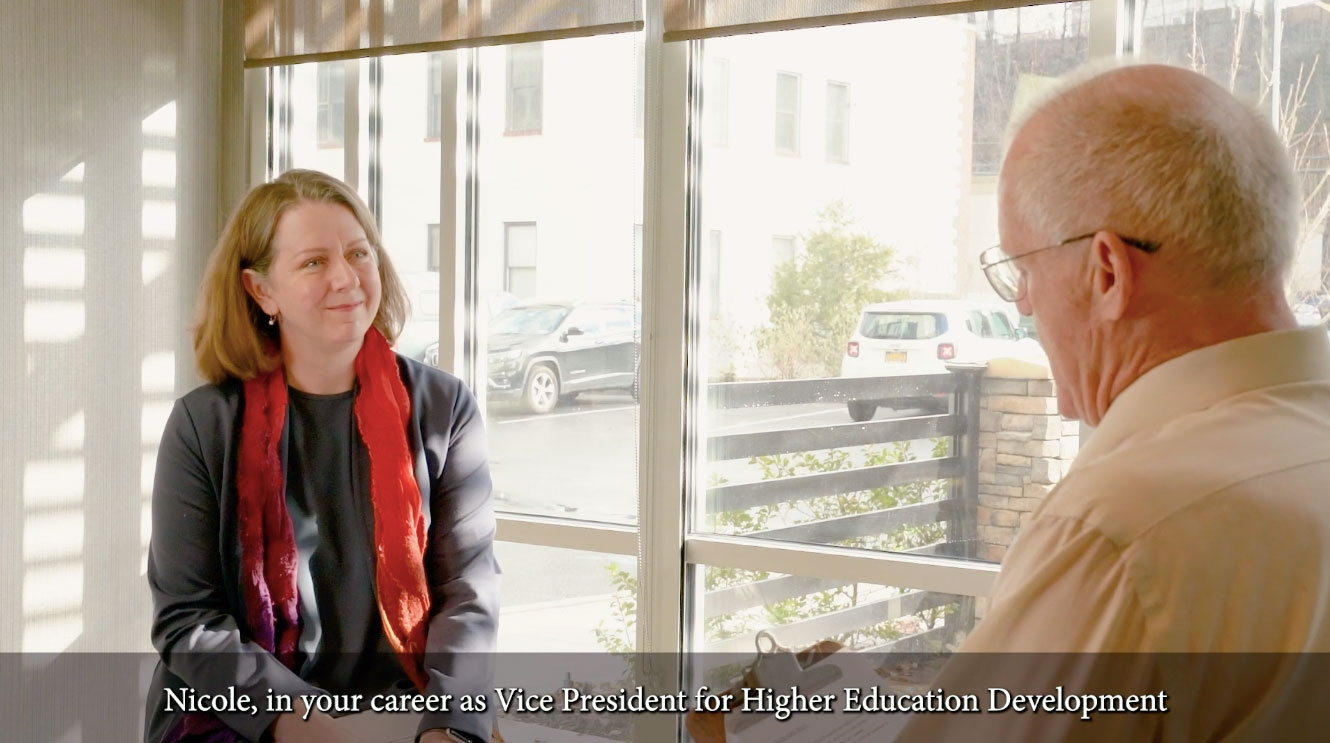
Nicole Engelbert talks with retired local reporter Peter Drumsta about her work at Oracle, her goals if she is elected Village Trustee, and more! Watch the video and read the transcript here.
Watch the video
Read the transcript
Nicole’s work at Oracle
[00:00]
[Peter Drumsta] We are speaking with Nicole Engelbert, candidate for Tuckahoe Village Trustee. Nicole, in your career as Vice President for Higher Education Development with the tech giant Oracle, you have a very visible, very leading-edge role. Can you describe your work and your career accomplishments in your role as a Trustee?
[00:21]
[Nicole Engelbert] Sure, Peter. I have the honor and the pleasure to spend my professional time working with colleges and universities around the country—really working with their leaders to address some of their biggest challenges facing higher education today about affordability, about how do we serve more students, about how do we grow and evolve our society and prepare students for work. And then I go back and build the technology that can empower those universities to make progress on those goals.
It might be a painful example for many residents out there, but we build the technology that helps you apply for financial aid or pay your tuition bills or even pay those darn parking fees you might get on many campuses. But it is very similar to what Tuckahoe is facing and what Tuckahoe is looking to do with its local government. We’re really grappling with, how do we provide better services to residents? And how do we reduce costs with efficiencies because of technology? And how do we help businesses grow faster?
It’s very clear that our website can use a little bit of an upgrade in the coming years. But, more seriously, we need to start thinking about and looking at how can we enable paying taxes online, enabling businesses and residents to apply for permits. And many other things.
However—and this is where I’m going to almost pause in the tech enthusiasm that we all have—we need to be really thoughtful about the costs. There needs to be a level of fiscal stewardship, because we are spending residents’ tax dollars to improve these services, from a technology perspective.
So, as a Village Trustee, I would bring my experience as an IT executive to really rigorously vet any choices we have made to invest in technology, to ensure that there will be rapid and long-standing concrete returns for residents and businesses from the investments we made in technology.
Nicole’s goals as Trustee
[02:57]
[Peter Drumsta] What are the primary goals you would like to advance and advocate for, as a Trustee?
[03:03]
[Nicole Engelbert] Well, before I get into the platform—which Cara and I are really, really excited about what it can bring to the Village—I just want to take a moment to comment on accountability. It’s really important for residents to expect more from their Village administration, from their Village Trustees, from the services of the town.
We are in a position where we’re elected because we’re making a promise to deliver something to improve the lives of residents in some way. It might be an arts festival on Marbledale. It might be improved flood mitigation efforts. It might be additional community services for families and children. Whatever it might be. But if Trustees don’t deliver real things to the residents—don’t improve their quality of life in a real way—then, I think it’s important to, out they go.
So Cara and I really want the Village of Tuckahoe to hold us accountable, to expect more from us if we get your vote and are elected into office. So, what do we want you to hold us accountable to? So, we have a platform. It has three key components, almost kind of legs on a stool.
So, the first one, and one I think is important to everyone in the Village, is growing the economic development of our town. And, a key component of this, of course, is Marbledale Road. But we’re really looking to expand the tax base in Tuckahoe without degrading the quality of life of its residents.
The second element—and this is the key part—the quality of life. How do we improve the quality of life? Now, the current administration in Tuckahoe has done an amazing job. Cara and team have the Creepy Crawl on Halloween with hundreds of children and their families walking down Main Street. Well, shoot, that’s why so many of us have moved to Tuckahoe in the first place. Or, of course, test kits, vaccines, FEMA intervention—the list goes on and on in terms of the level of service the Village provided over the last year to improve the quality of life in Tuckahoe. And so that is something we will build on, and you’ll be able to see that and you’ll be able to experience that for yourselves, as residents.
The third is that we cannot, absolutely cannot, lose sight of investing in public safety and infrastructure. We have a community policing team that is the envy of the County, if not the State. And we need to protect that service with continued investment and proactive thinking, so they continue doing what they do best. But we also need to look to the future.
The flood this past year was devastating for so many in the town. I mean, the pictures, and seeing—I don’t think I’ll ever forget hearing this horn honking because a truck was stuck on the Bronx River Parkway for hours. And we need to address that. Now, flood mitigation—not something Tuckahoe can do on its own. So we’re going to have to work with the County, the State, and the Feds, to garner resources and expertise. And so we’re going to ask that you hold us accountable, that we make good progress on building that flood mitigation plan.
On supporting Tuckahoe’s police department, fire department, and DPW
[07:08]
[Peter Drumsta] The safety and security of all residents, naturally, that always has to be the top priority of public officials. So you believe that Village residents can have full confidence right now in the services of their police and fire departments?
[07:24]
[Nicole Engelbert] Well, the easiest question I expect to be asked every day on this campaign is, should we be proud of our police department, our fire department, our DPW? Yes, absolutely. They are absolutely best in class. They make, in so many ways, they make Tuckahoe, Tuckahoe. And I put our team against any village’s team in Westchester, if not across the state—both in probably softball teams, but also in delivering services to the community.
I don’t think I will ever forget, or my family will ever forget, on Earth Day this past year, the DPW came and they planted a tree in our front yard. I mean, Tuckahoe is a Tree City, so that makes sense. And trees improve our quality of life, and they also have some really good infrastructure components too. But, beyond the wonderfulness of having this beautiful tree, was also that the DPW came on a regular basis and watered the tree. And so it was an investment, not just in planting the thing, but also ensuring that it would thrive, that it would survive the winter and the spring, it would bloom, and birds would be in it, and all that great stuff.
And I think that is a good analogy or a parallel to what the Village needs to continue doing with its police, fire, and DPW services. It’s not just about a one-time investment. It’s about continuous support to ensure that they can thrive and flourish. So, we don’t just plant the seeds with our public services. We invest in them so that they grow and blossom.
Nicole’s experience growing up in Ballston Lake, NY
[09:23]
[Peter Drumsta] Could you talk about your early years growing up in northern New York State and how that shaped your sense of community?
[09:33]
[Nicole Engelbert] Absolutely. So I am, I’ll admit it right up front. I’m an upstate girl. And not just north of White Plains. I’m like north of Albany, just south of the Adirondack Mountains. So, I grew up in a small town called Ballston Lake. And, in many regards, it’s quite similar to Tuckahoe—small town. My goodness, I went to the same high school—elementary school too—as my parents did. And my grandparents actually worked at the school district as well. My grandfather was a shop teacher—hope they still have shop teachers because that’s super, super important life skills—and my grandma was the crossing guard at the elementary school. So she helped me cross Lake Hill Road over to Stevens Elementary School—a little embarrassing for a fifth grader, but it was all good.
Ballston Lake was, while not diverse on some measures, was actually highly diverse from an economic perspective. And that was a function of being upstate, which has some economic challenges. But it was also in commuting distance to Schenectady where, at the time, GE had a lot of executives as well as a lot of factories. So, in our town we would have both GE executives, but also line workers in the turbine factory, and small business owners, state employees, teachers—the whole nine yards. But because we had such strong local government, and because we had such a community spirit, it worked, and to the benefit of everyone in the town. You have a much broader view of what are the needs of your neighbors and your people and what a community could be. And they’ve come together to support the beautiful lake. They passed sewers in the past year, maybe 18 months at this point, which was absolutely amazing. My grandfather, God rest his soul, is smiling in his grave. They’ve protected outdoor spaces. And they’ve even continued to have state champion athletic teams—go Spartans!—but I hope to bring that spirit of celebrating our community and serving the needs of everyone in its entirety, not pieces, but the whole.
On Tuckahoe's rich history
[12:17]
[Peter Drumsta] Tuckahoe is a small village geographically, but it has a very rich history nonetheless. What’s being done to preserve that history, and how do you think Tuckahoe’s past enhances its present-day quality of life?
[12:32]
[Nicole Engelbert] Absolutely. Tuckahoe has a rich and proud history. My goodness. Our history of marble is something we talk about in our schools—but something, you know, when you’re different, in state buildings, you know, you’re like, that marble is from my hometown, which is wonderful. But there’s more to it than that. There’s a quality of life issue that our history brings to bear.
So, I live very close to the Church of the Assumption. On a good day, my husband, if he played really well could probably hit a golf ball with his driver from our house to the Church of the Assumption. That will never happen because it’s very dangerous. You should not be hitting golf balls in your backyard. Leave that to Lake Isle, leave that to Leewood. But it’s that close. And so, I hear the bells of Assumption Church on a regular basis. And I can’t tell you the kind of peace it brings me to hear them. First, they’re beautiful. But, also, it is a reminder of the larger community that I live in, the larger purpose that I’m part of.
So, it’s critically important that we protect those types of things, because they add so much. But historic preservation must be balanced with practical economic realities and the wants and needs or preferences of the residents. And that’s why I was so excited, so proud, that the current administration passed the Village of Tuckahoe Historic Preservation Law and put together a bipartisan task force to shepherd the execution of it. Because I think they’re going to bring that balance to life, and both protect our history, but also improve the quality of life and ensure economic sustainability as well.
[14:39]
[Peter Drumsta] Nicole Engelbert, thank you so much for your time.
[14:41]
[Nicole Engelbert] Thank you, it was a pleasure.





